

Over 47 million Nigerians still practice open defecation (OD), and Enugu state is not exempted as about 47 percent of the populace still practice open defecation. Open defecation (OD) poses a significant sanitation challenge in various communities across Enugu State. It leads to adverse health effects and environmental pollution.
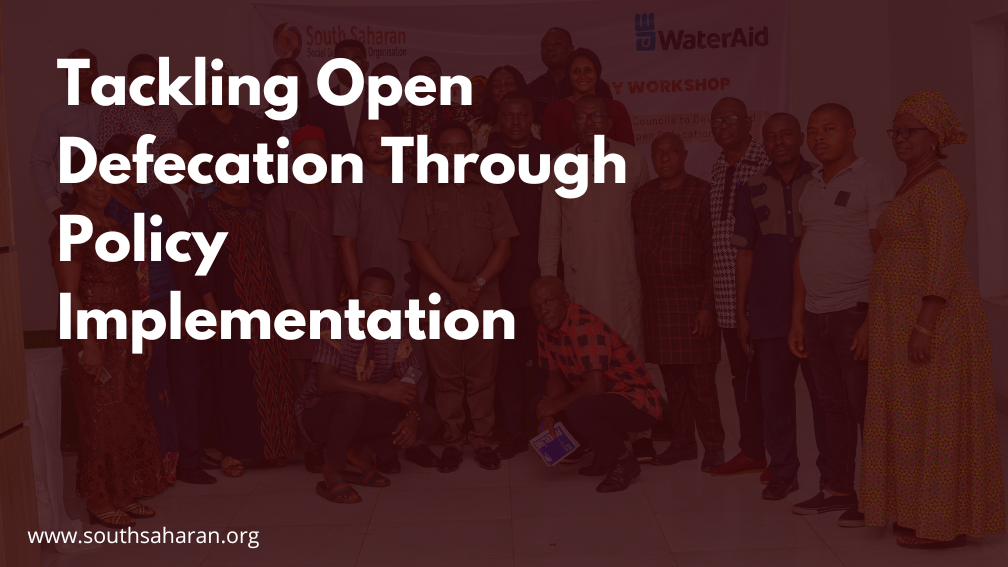
Understanding this challenge, South Saharan Social Development Organization, SSDO, in partnership with WaterAid Nigeria, under the Bill and Melinda Gates Foundation project organized a 2-day Sanitation Advocacy Workshop to address this issue. The workshop targeted six communities, precisely two communities per Local Government Area (Igbo Eze North, Nsukka and Udenu) in the Enugu North Senatorial zone of the state.

The workshop’s primary objective was to empower the communities and local government authorities (LGAs) to develop and implement an Anti-Open Defecation by-law to end open defecation in their communities. The workshop had a community-led approach and had leaders of the legislative council, president generals, women and youth leaders, WASH coordinators, and CSO partners in attendance.
The first session of the day was expertly facilitated by Emmanuel Obuna, the Sanitation Officer of ENSTOWA. His session delved into the pressing issue of open defecation and the imperative of curbing this practice at the community level. Participants were enlightened on the pivotal role of community-led sanitation and hygiene initiatives, gaining insights into the historical evolution of sanitation practices in Enugu metropolis. Key concepts such as Community-Led Total Sanitation and Sanitation Marketing were elucidated, emphasizing their relevance and effectiveness in achieving sustainable sanitation outcomes.

Building upon the foundation laid by the previous session, Dr. Umoh Boniface, a distinguished WASH consultant and senior lecturer at the University of Nigeria, Nsukka, led an extensive and interactive session on the vital role of Water, Sanitation, and Hygiene (WASH) in community development. This dynamic session provided a platform for participants to share their experiences related to open defecation, fostering a collective understanding of the challenges at hand. From the shared experiences, key factors contributing to open defecation were identified, including the lack of inclusive toilets for persons with disabilities, inadequate clean toilet facilities in government places and institutions, and a shortage of toilets in public spaces, particularly for travellers.

During this session, the WASH Coordinator of Igbo Eze North LGA emphasized the crucial need for cooperation and active involvement from government officials in empowering and enforcing relevant by-laws. Participants unanimously agreed that enacting by-laws through community leaders and engaging town unions in markets and public places would effectively facilitate the implementation of these laws.
To deepen participants’ understanding of the severity and consequences of open defecation, a compelling sanitation advocacy animated video was screened. The video vividly depicted the direct link between open defecation, the spread of illnesses, and the associated health risks. This visual presentation served as a powerful catalyst, evoking a heightened sense of urgency and reinforcing the critical need for collective action.

As the day progressed, participants were divided into groups according to their respective LGAs—Igbo Eze North, Udenu, and others—each group tasked with deliberating and developing a comprehensive framework. These frameworks highlighted the specific challenges related to poor sanitation in their LGAs, proposed innovative solutions to address these challenges, outlined detailed action plans with designated responsible individuals, and established timeframes to achieve the esteemed goal of attaining Open Defecation Free (ODF) status in their communities.

Day 2
Following the previous session, Dr. Umoh proceeded with a comprehensive session on By-Law against open defecation: contextual imperative & implication for communities in Enugu State. During this session, he provided an informative overview of a well-structured by-law, highlighting its key qualities and essential content. These elements encompassed:
• Title: A clear and descriptive title that accurately represents the purpose of the by-law.
• Date made: The date on which the by-law is officially established.
• Citation: The specific reference or legal citation that identifies the by-law.
• Objectives of the by-law: Clearly defined goals and objectives that the by-law aims to achieve in addressing the issue at hand.
• Definition of terms: A section that provides clear and concise definitions of relevant terms and concepts used within the by-law, ensuring a common understanding among stakeholders.
• Application: The scope and applicability of the by-law, specifying the areas, entities, or individuals to which it applies.
• Sanitation Trust Fund (STF) Establishment: The establishment of a dedicated Sanitation Trust Fund, which serves as a financial mechanism to support and sustain sanitation initiatives.
• Purpose of the STF: A clear articulation of the objectives and intended use of the Sanitation Trust Fund, such as funding infrastructure projects, awareness campaigns, or capacity-building activities.
• Appropriation of the Sanitation Trust Fund: Guidelines and procedures for allocating and managing funds within the Sanitation Trust Fund, ensuring transparency and accountability.
By outlining these essential components, Dr. Umoh provided valuable insights into the fundamental aspects that should be considered when developing a comprehensive by-law targeting open defecation. Equipped with this knowledge, the participants were then regrouped into their respective Local Government Areas (LGAs) to collaboratively develop context-specific draft by-laws aimed at eradicating open defecation within their communities.
Going Forward
The Sanitation Advocacy Workshop significantly empowered communities and local government councils to address the challenge of open defecation in their localities. The workshop created awareness, built capacity, and fostered community-led solutions toward ending open defecation. The collaboration between WaterAid, SSDO, and the participating communities and LGAs resulted in developing context-specific draft by-laws and action plans. The workshop’s outcomes will contribute to the sustainable implementation and enforcement of by-laws, improving sanitation practices and eradicating open defecation in Enugu State.