

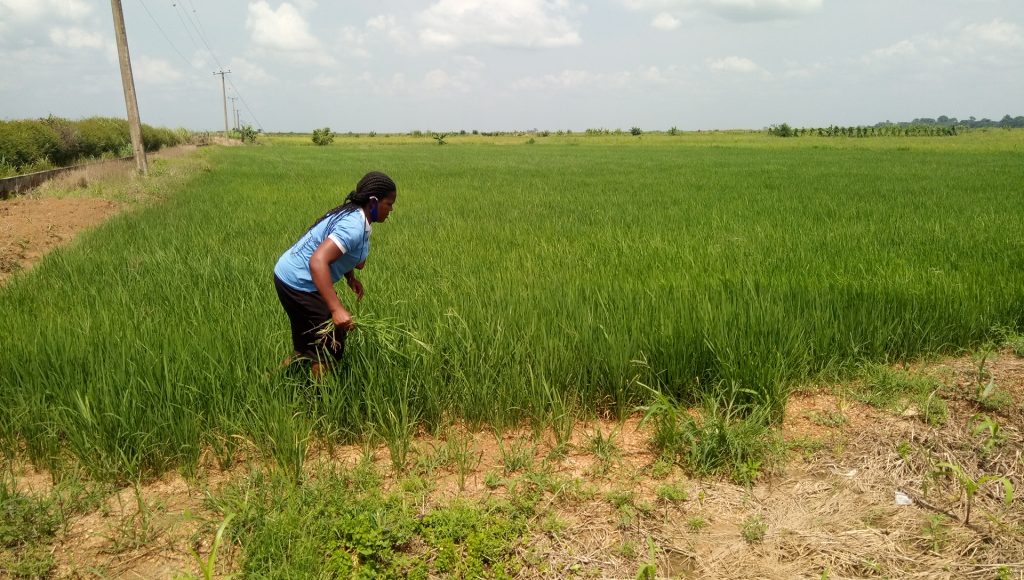
Woman weeding her plantation
“I can’t go to the farm anymore. You don’t know where or when they will attack,” Chigozie explains.
This has been the situation of farmers in communities in Uzo-Uwani LGA, Enugu State. On the 25th of July 2021, herders attacked Obie Akwu farm camp where few people died and many were injured. This has disrupted the normal proceedings of the communities whose chief occupation is farming. Now, farmers are scared to return to the farms for fear of being attacked.
The herders-farmers crisis has been an ongoing issue in the country and has recently become a cause of concern in the Southeast. As remote communities have been frequently attacked in recent months.
“I buy farm products from farmers to sell in the market. Since the attack there’s been little activity from the farmers,” Onyinye, a fruit seller said.
Many women in Uzo-Uwani communities are traders. Some buy farm produce from farmers and sell it in the market. Other women engage in farming and proceed to sell the products themselves. Thus, raising money to fend for themselves and support their families.
However, many of these women deal in small quantities. Buying and selling as much as they can to break even and stay afloat. There is a limit to how they can support their family and look to attain financial independence.
Women like Onyinye abound across communities in Enugu and the country at large who make barely enough to cater to their needs. Coupled with the insecurity the communities in Uzo-Uwani face, it is worse off.
“I barely make enough profit to buy books and clothes for my kids, talk less of taking care of myself,” Onyinye said.
In 2019, Onyinye came in contact with South Saharan Social Development Organization (SSDO) during one of their community outreaches to Uzo-Uwani.
“I met some officials from SSDO and they told me I could access loans from their organization to grow my business. I was so excited.”
SSDO through its Jacob’s Well initiative aims at improving the quality of life for women in Enugu state by providing micro-credit facilities. The objective of the project is to empower women to gain financial independence, reduce poverty and over-dependency.

Onyinye has been able to grow her business after acquiring some loans. She can now buy fruits in more quantities and expand her business.
“I use to buy fruits in small quantities before from those who buy from the farm. Some oranges, bananas, and a few watermelons. With the loans, I have been able to grow my business. I buy in bags directly from the farm. I am grateful to SSDO for the opportunity.”
These loans are made available with a cooperative as a third party. Only women who are duly registered with these cooperatives can benefit from the loans. Once a loan is cleared off, the women can reapply for another one. Thus, steadily growing their businesses.
Things have however changed, the recent attack has made it difficult for business activities to continue as normal. Not just that, female businesses that have been empowered through the Jacob’s Well Initiative might suffer as well. Women take loans from SSDO to grow their businesses then refund the loans gradually after making profit. With the level of insecurity, this might no longer be visible.
“With the current situation of things, I don’t know when I will be able to go the farm again. I also cannot take another loan because I’m not sure of how things will turn out”.
The same also can be said for Theresa a rice farmer in Adani community. She gets loans from SSDO and has scaled up her business. However, the current situation in the community has brought all activities to a standstill.

“Since the incident, I’ve not been able to go to the farm. And that is where we carry out the parboiling and the sieving of the rice as well. So now we are stranded.”
This poses a new challenge for women in these communities. Access to funds was usually the problem but this new status quo looks to threaten the progress that has been made with women empowerment in these communities.
